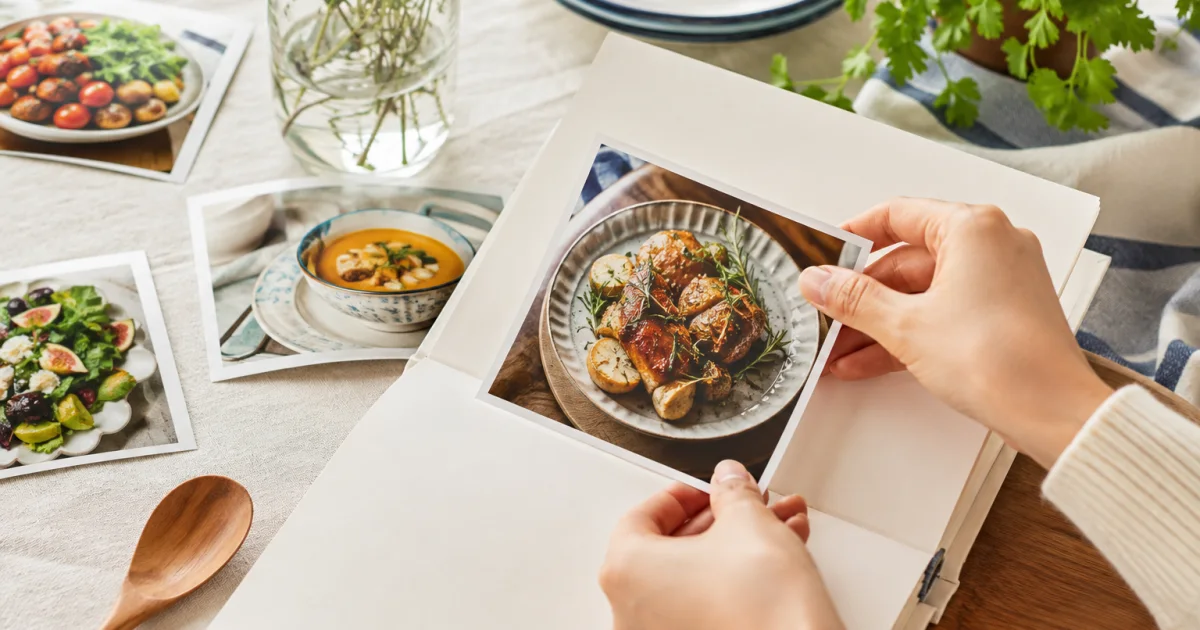
Find the original quantities behind your food photo
If an old food photo makes you want to prepare a smaller batch, find the recipe connected with it first. You need confirmed ingredient names, amounts, units and original servings before calculating. A large-looking bowl does not tell you how many grams went into it.
The yogurt bowl below is a fictional arithmetic exercise created by the editorial team, not a tested recipe. Assume four servings use 400 g yogurt, 80 g oats, 200 g fruit and 2 teaspoons honey. For actual cooking, check the quantities and instructions in a reliable original recipe.
Keep the serving size fixed and work out the factor
The conversion factor is the number of servings you want divided by the original number. Reducing four equal-sized servings to three gives 3 ÷ 4 = 0.75. Multiply each ingredient by 0.75 to calculate the new amount. Changing the size of an individual serving at the same time changes the basis of this comparison.
Keep the original units, whether grams, milliliters or teaspoons, for your first calculation. You can read 1.5 teaspoons as one teaspoon plus half a teaspoon. An ordinary spoon is not necessarily the measuring unit intended by the recipe, so check that unit before using it.
Four steps from the original amounts to the new ones
Copy the original serving count and each ingredient’s amount and unit. If you have only a photo and cannot confirm the quantities, leave scaling for later.
Choose the new number of servings while keeping each serving the same size. Divide the new count by the original count and write the factor above your worksheet.
Multiply each ingredient amount by that factor. Keep its unit and express fractions or decimals in a form you can measure.
Divide each calculated amount by the factor to check that it returns to the original. When you make the dish, record actual amounts separately beside the calculation.
A completed four-line worksheet: four servings to three
The fictional worksheet starts with “Original: 4 servings → Target: 3 servings; factor: 3 ÷ 4 = 0.75.” Each line below keeps the same serving size. These are calculated amounts; nothing has yet been recorded as actually used.
Yogurt: original 400 g × 0.75 = 300 g calculated for three servings.
Oats: original 80 g × 0.75 = 60 g calculated for three servings.
Fruit: original 200 g × 0.75 = 150 g calculated for three servings.
Honey: original 2 teaspoons × 0.75 = 1.5 teaspoons calculated for three servings.
Check the arithmetic without changing the units
The reverse calculations are 300 g ÷ 0.75 = 400 g, 60 g ÷ 0.75 = 80 g, 150 g ÷ 0.75 = 200 g, and 1.5 teaspoons ÷ 0.75 = 2 teaspoons. Returning to the original amounts gives you another check on the factor and multiplication. Do not replace a number in grams with the same number in milliliters for convenience.
You can also check an increase. Going from four servings to six gives 6 ÷ 4 = 1.5: 600 g yogurt, 120 g oats, 300 g fruit and 3 teaspoons honey. Dividing each by 1.5 returns 400 g, 80 g, 200 g and 2 teaspoons. Check that you have not mixed the 0.75 and 1.5 factors within one worksheet.
Treat cooking conditions and results separately
Correct ingredient arithmetic does not establish that the flavor and texture will stay the same. The Culinary Institute of America’s guidance discusses baking ingredients such as leaveners, flavorings and thickeners, as well as equipment, mixing and baking conditions, separately. Larger changes may call for the original recipe’s scaling instructions and a test batch.
Do not apply the 0.75 factor to cooking time or temperature. Keeping calculated quantities, actual amounts, equipment and results separate gives you something specific to check next time. This worksheet does not assess flavor, nutrition or cooking safety.
Connect the worksheet with the food you actually make
After making the dish, keep a finished-food photo and a short quantity note on the relevant date. Pogaem titles allow up to 40 characters and bodies up to 500. Leave a long recipe and full worksheet in their original location, referring to them by a short name. Pogaem holds the photos you select and the title and text you write yourself.
An editorial note example uses the title “Yogurt bowl: 3 servings” and the body “Original: 4 servings; factor 0.75. Calculated: yogurt 300 g, oats 60 g, fruit 150 g, honey 1.5 tsp. Actual amounts: check after making. Source: cooking notebook, p. 8.” This short note connects the photograph with the calculation. Replace the actual-amount placeholder yourself after checking what you used.
Frequently asked questions
Can I change both the serving count and the amount per person?
This worksheet keeps the size of each serving the same. If you also want to change that size, define it first and compare it with the original recipe. Changing both conditions requires more than multiplying by the ratio of people alone.
Can I use the same number for grams and milliliters?
No. Grams measure mass and milliliters measure volume; their relationship depends on the ingredient. Calculate in the original unit. If you need another unit, use a conversion you can verify for that particular ingredient.
Does Pogaem read the recipe in a photo and scale it automatically?
No. The factor, worksheet and arithmetic checks here are work you do yourself. Pogaem can hold a food photograph and short manual notes; this method does not assume recipe recognition or automatic scaling.
Sources
- Culinary Institute of America: recipe factors and cooking conditions · Accessed: 2026-11-08
- King Arthur Baking: reducing a recipe · Accessed: 2026-11-08