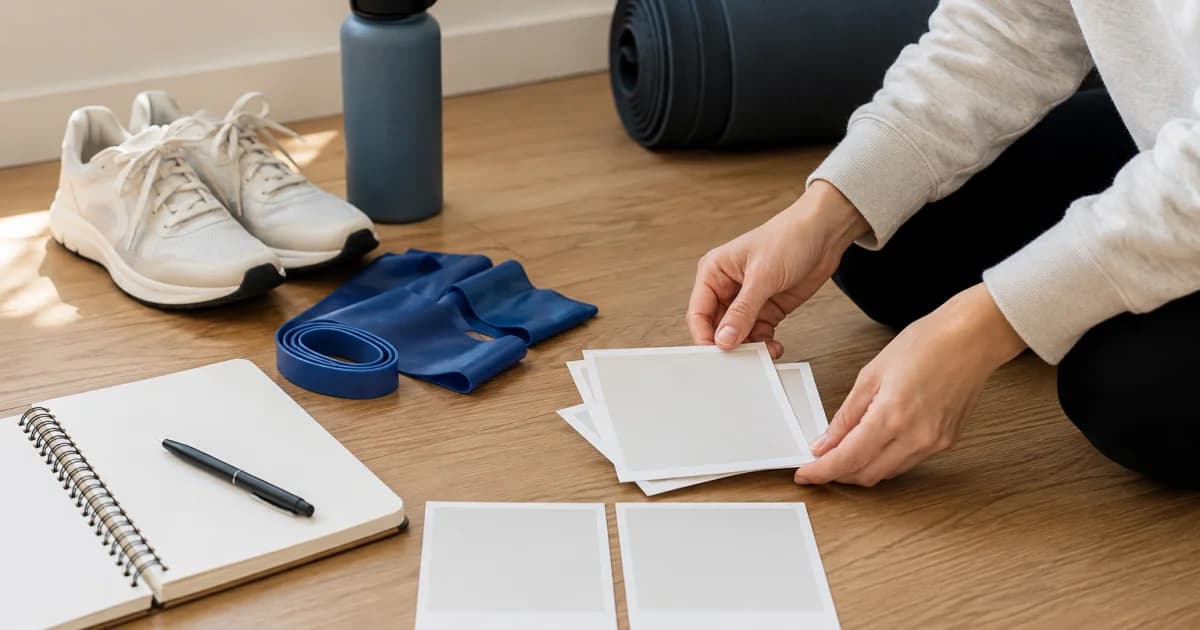
Find one moment that brings the run back
After a run, think about the first scene that comes to mind. It might be a familiar shop switching on its lights, a conversation with someone running beside you, or taking off your shoes at home. You do not have to describe every part of the outing from departure to return.
Add a detail that makes “I went for a run” belong to this day. What were you thinking about at the start, and what later caught your attention? If the day felt much like any other, you can say so. The entry does not need an exceptional moment to earn its place.
Give one run a short story in four steps
Choose the day you actually ran and one moment that comes to mind first.
Write what you did just before and after that moment, with your own thoughts or feelings.
Connect a choice you made or something you want to remember to bring the short story to an end.
Keep the text and any photo chosen after stopping on the relevant date, adding only numbers you actually checked.
Bring the scene and your response together
An invented editorial entry reads: “I left home still thinking about messages I had not answered. The bakery I always pass had its lights on, and I smelled bread near the door. On the way back I kept thinking about that window. At home, I wrote down that the bakery light was what I remembered today.” There is a particular run to return to without a table of distances.
This example does not have to supply the ending of every entry. Your thoughts may have stayed tangled, or nothing may stand out at all. Write how that run felt to you without turning one pleasant scene into a claim that running always changes your mood.
Keep the account in your own voice, even with company
If you talked with a running companion, keep a phrase you remember accurately or summarize the conversation. Avoid deciding that your friend enjoyed the run just because you did. When the exact wording is uncertain, name the subject you discussed instead of presenting a reconstructed line as a quotation.
A choice made on a solo run can also finish the story. “By the end I wanted to get home and make tea” says something about your afternoon. It can remain the ending of this experience, without becoming a target for next time or advice about how far or fast to run.
Let numbers sit beside the scene
If you checked distance or time in another tool, you can record the value and what it refers to. The diary can also be complete without it. Do not treat the interval between departure and return photos as measured running time, or use a few photographs to reconstruct an exact route.
Two runs with similar numbers may leave different memories. One day brings back a conversation; another brings back a lit window at dusk. Read the separate stories without needing to decide which was the better performance. The scene has a different job from the figure beside it.
Use a photo taken after stopping, or simply write
Write your title and account in a Pogaem personal calendar and, if you want, add a photo of your shoes or the path taken after you stopped. There is no need to finish the record while running. A scene you remember afterward can stay in words even when you never photographed it.
Pogaem holds the photos you choose and the experience you write yourself. This method does not measure GPS routes, pace, or calories, or provide training instructions. The entry is a piece of your everyday life to revisit, rather than an assessment of your body or recovery.
Frequently asked questions
Can I keep a running journal without knowing my distance or time?
Yes. Write a remembered scene, your own thoughts, and what you actually did. You do not need to estimate exercise time from the gap between photographs.
Does every entry need a positive ending?
Keep the feeling you actually had. If your thoughts were still busy afterward, say so rather than inventing an improved mood to finish the story.
Do I need to take photographs during the run?
A photo after you stop, or text alone, is enough. Make clear when the photo was taken if your writing recalls an earlier moment.