Choose who will look and what you want them to notice
To write labels for a home exhibition, choose an audience and one theme, then give each object a name, checked facts, and something to look at. Place each label beside its object so a first-time visitor can match the words to what they see.
Your audience could be “a friend visiting my home for the first time,” and your theme could be “surfaces changed by use.” Choose objects that show that theme and write an individual looking prompt for each, rather than combining them into one self-introduction. Use as few or as many objects as the theme needs.
Separate known information from your interpretation
For the information line, record supported details such as material, how you obtained it, or when you used it. Write “maker and date unknown” if that is all you know. Looking old does not establish that an object is an antique or belongs to a particular period.
The interpretation line tells the viewer what to notice. Point to something visible, such as “the inside of the handle is darker than the outside.” Do not invent a maker’s intention. If you include a recollection, introduce it as something you remember.
Three finished labels under one theme
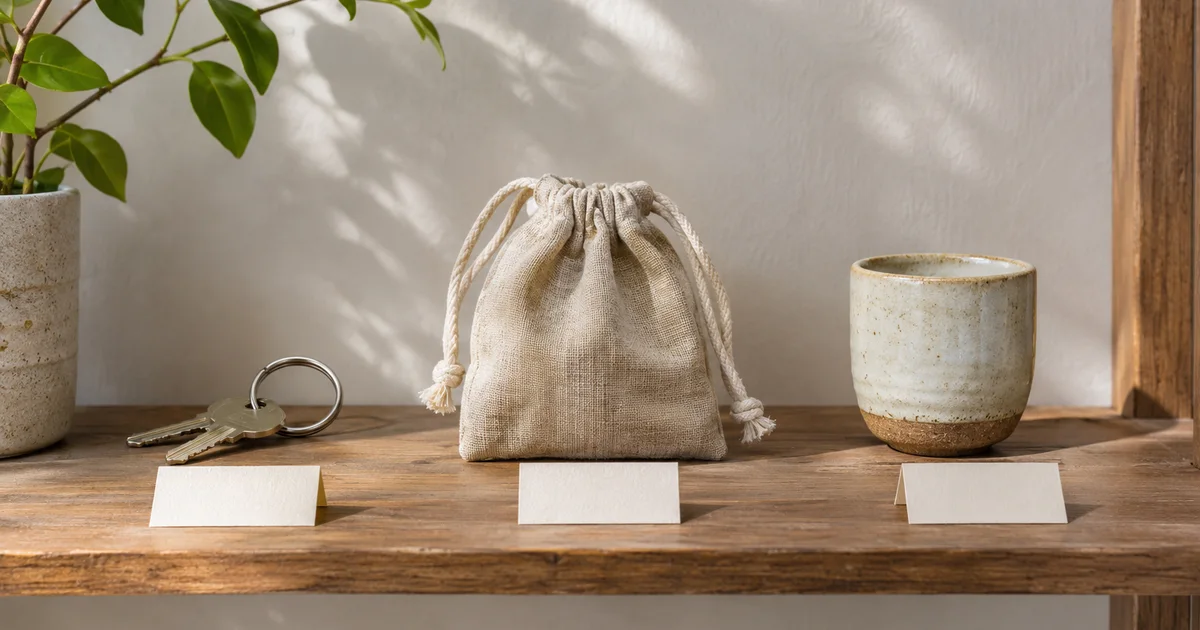
These objects and histories are editorial inventions. The exhibition is called “Where Hands Have Been,” for a visiting friend. Label one: “Worn key ring / known facts: used by me since 2021; maker unknown / looking prompt: Compare the corner nearest the ring with the middle surface. How does the part often held look different?”
Label two: “Fabric pouch / known facts: a pouch I patched by hand; I do not remember when / looking prompt: Find the join between the original cloth and the patch. Even where the colours match, the stitching shows the boundary.”
Label three: “Cup for paintbrushes / known facts: a cup I used for art tools; manufacture date unknown / looking prompt: Compare the colour marks inside with the clean outer surface. This exhibition looks at the surfaces use has left behind.” The labels share a theme while directing attention to different visible details.
Match the labels to the objects
Choose an audience and write a one-sentence theme. Select objects that can show it in person.
Separate known and unknown information for each object, then write one or two sentences directing the visitor’s attention.
Place each label beside its object. Check that the title points to the right thing and that the described detail is visible.
Read the labels aloud from a first-time visitor’s perspective, trim what is unnecessary, and photograph the whole display and individual objects.
Decide whether visitors may touch
If someone must lift an object to see the described detail, you could add a detail photo or change the arrangement. Decide how a fragile or hands-off object can be viewed. Labels can stand beside objects without tape being applied to their surfaces.
Use another household member’s belongings only with their agreement. Leave private details such as letter addresses or a key’s cut pattern out of the labels and photos. You can invite people to notice everyday differences without appraising the objects or assigning them a price.
Keep the display and finished words in Pogaem
On the exhibition date, keep an overall photo, individual object photos, and the label text you wrote in a Pogaem entry. Use the exhibition name as the title and add the audience and theme to the body. If you later change the objects or write new labels, make a dated record of the new arrangement so you can revisit that version of your small exhibition.
Frequently asked questions
Do the objects need to be rare or old?
No. Everyday things work when they visibly support your theme. Do not invent history or value to fill gaps in their documentation.
Can I include a personal memory?
Yes. Distinguish it from checked information and also give the visitor something to notice in the actual object.
Should a label tell the whole story?
Choose enough to connect the object with the theme for a first-time viewer. Keep longer personal stories in a separate note and put a short, readable text beside the object.