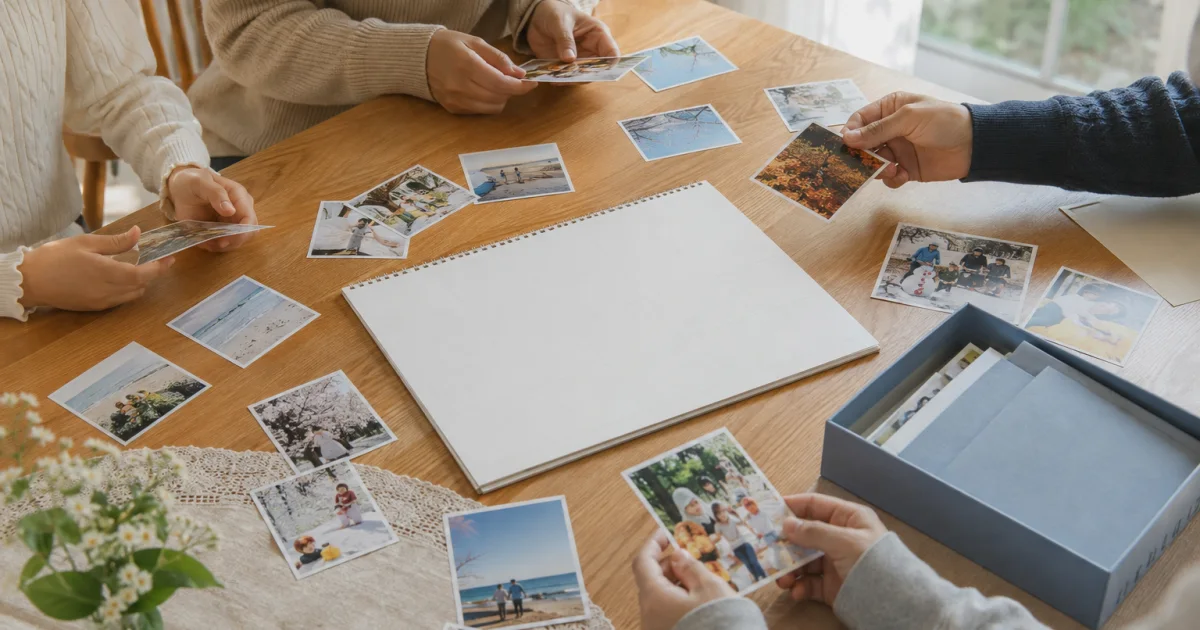
Choose photographs everyone agrees to use
Prepare a family photo quiz as a small observation game with the pictures in view. Questions about visible colors, counts and objects let you define the game without competing over who remembers a date best. Check with the people pictured before using a scene together.
Begin with the objects and actions you can see, separating observation from inference, as in the National Archives photograph worksheet. The questions, scoring and hosting rules here are editorial suggestions, not a way to assess memory or family relationships. Leave out any photograph or question someone does not want to use.
Check the visible facts in three fictional scenes
Fictional scene A: a yellow raincoat and a blue umbrella are in an entrance hall, with two red boots on the floor. The editorial team created this written scene for the exercise. There is no actual sample photograph to open.
Fictional scene B: two oranges and three cups sit on a red checked blanket. The details used here are the blanket’s pattern and the cup count. The description does not identify a place or people, so do not ask for those as answers.
Fictional scene C: a paper boat and a yellow toy duck float on water. You can practice by rereading the three written descriptions. For a real photo round, the host should open the chosen pictures at a useful size and check that each object and color is clearly visible.
Four steps to prepare and host the round
Choose three actual photos everyone agrees to use and label them A, B and C. Check for faces, addresses, school names and other details you do not want to show.
Write two questions about visible facts in each photo. First put the answer and the place to check it on a host-only sheet or separate document, comparing each with the photograph.
Show players only the photos and questions. If scoring, explain before starting: one point per question, equivalent words accepted, and anyone may pass.
Once everyone has chosen an answer, reveal the matching numbered answer and its location in the image. Void unclear questions or those with two possible answers, removing them from the score.
Six questions to read with the pictures in view
Question 1 · Scene A: What color are the boots on the entrance-hall floor?
Question 2 · Scene A: What color is the umbrella?
Question 3 · Scene B: How many cups are on the blanket?
Question 4 · Scene B: What pattern is on the red blanket?
Question 5 · Scene C: Which object on the water is made of paper?
Question 6 · Scene C: What color is the toy duck?
The host’s six answers and where to check them
Answer 1 · Red. Check the two boots on the entrance-hall floor in scene A. Accept “red boots” as the same answer.
Answer 2 · Blue. Check the umbrella beside the raincoat in scene A. “The blue one” is also an acceptable answer.
Answer 3 · Three. Check the three cups on the blanket in scene B. Do not count the two oranges as cups.
Answer 4 · Checks. Check the pattern on the red blanket in scene B. Accept “a grid” if the player means the same pattern.
Answer 5 · The paper boat. Check the boat on the water in scene C. “A boat folded from paper” also identifies it.
Answer 6 · Yellow. Check the toy duck’s color in scene C. Accept “the yellow duck” as the same answer.
Explain reveals, unclear answers and passing
The host keeps the key on paper or in a separate document so it is not visible while a question is being answered. This explanatory article shows all questions and answers, so copy them separately to host a round. Pogaem does not provide a quiz screen that hides the answers.
If a cup in an actual photograph is partly hidden and allows different counts, void the question. Do not insist on a color when it looks ambiguous on different screens. Players may pass without explaining, and you can skip scoring entirely. An unclear question is not a basis for judging a player’s powers of observation.
Keep a short record of the photos and the round
After playing, keep the photographs used and one thing to change next time. A manual Pogaem body example is “Family photo quiz, round 1. A: boot and umbrella colors. B: cup count and blanket pattern. C: paper object and duck color. Key: host’s paper notebook. Next time: choose a photo with all cups visible.” This preparation note stays under 500 characters.
If the complete six questions and key grow long, keep the external host document and put only the agreed photographs and a short note in Pogaem. Writing a shared entry requires the calendar’s actual permissions and an internet connection. Calling it a game record does not make an unwanted photograph okay to share.
Frequently asked questions
Can I ask about dates or names only the family knows?
This game asks players to find visible facts together. Hidden dates and names are difficult to check from the photo alone, so save them for a separate conversation. Avoid treating family memories as right or wrong answers.
What if a question has two reasonable answers?
Reread the question and picture. If both interpretations work, void that question. Accept equivalent words, and choose a clearer photograph or question next time instead of forcing players to select one answer.
Does Pogaem create the quiz and a hidden answer screen?
No. You write the questions and answers, and the host keeps the key separately. Pogaem holds photographs and short manual notes; this method does not assume automatic quiz generation, answer hiding or score calculation.
Sources
- National Archives: observing visible details in a photograph · Accessed: 2026-11-08