Trace one square before you thread the needle
Put your finger on a square you want to stitch. Find its symbol in the key that came with the chart, then match the listed brand and number to the band on the actual floss. Label that bundle. The same symbol can stand for a different thread on another chart.
Read three squares with just two symbols
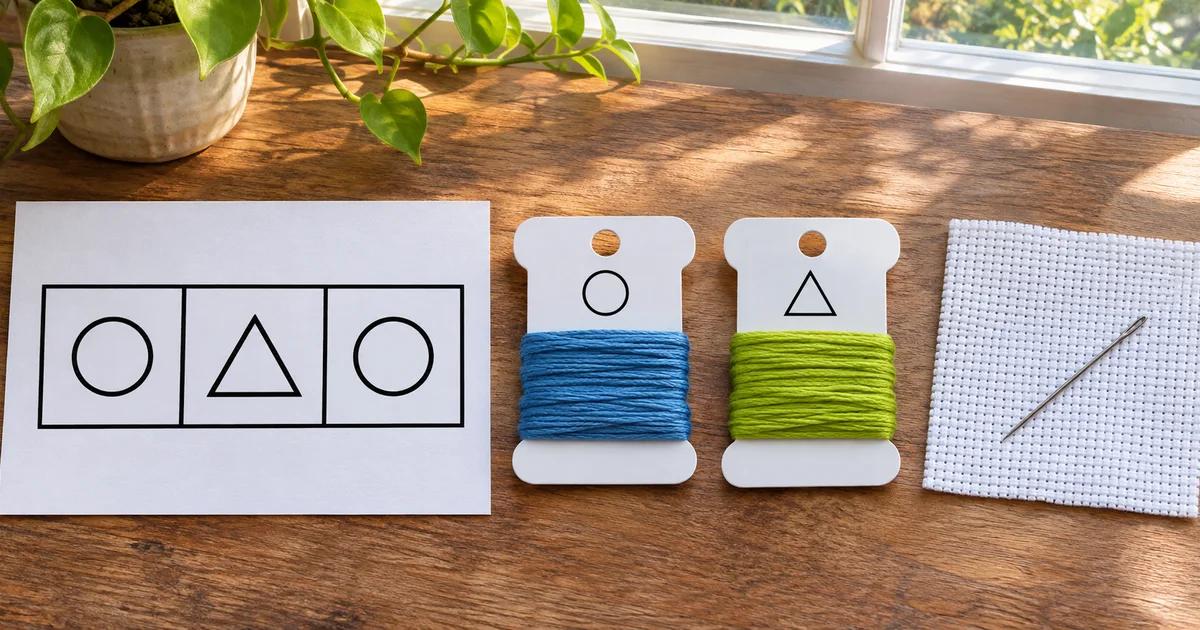
Our invented practice row reads ○ △ ○ from left to right. For this exercise, let ○ stand for blue thread A and △ for yellow-green thread B. The letters are local names for the exercise, so you won’t find them in a manufacturer’s color catalogue.
Point to the first circle and find card A. The middle triangle takes card B, and the last circle sends you back to A. Read the row aloud as “A, B, A,” then lay a bit of the matching thread under each square to check your route.
Make a card for each bundle
Write the project name on two scraps of card. Mark the first with ○ and A, the second with △ and B. Loop a sample of the matching thread through each card.
For a real project, replace A and B with the brand and number specified in its key, checking them against the original bands. Keep each band beside its card while you work.
Pick a square. Follow its symbol through the key to its card, then trace back to the square. Resolve a mismatched number before threading your needle.
When two colors look alike or a band is missing
Minori Koubou’s published chart shows grid symbols and a list of numbered threads on the same sheet. When a screen color is ambiguous, go back to your project’s symbol and number. Put a loose thread on a separate “number unknown” card if you can’t verify its identity.
Keep a view of your first stitches
On the work date in Pogaem, save a picture of your own thread cards and the first three stitches. Put the project name in the title and the symbols you confused in the note. Your cards and your own stitches give you a reference for the next row.
Frequently asked questions
Does a circle always mean blue?
It means blue in this practice row. Check the key supplied with each new chart.
How do I keep similar symbols apart?
Draw the tricky pair larger on separate cards. For an empty square and a filled square, point to the printed mark and check which one has a solid center.
Can I use leftover thread for the next project?
Check the brand and number on its band against the new chart’s key. Keep the old project’s circle or triangle on its original card.
Sources
- Minori Koubou cross-stitch chart and numbered thread key · Accessed: 2026-11-22