Start at the tip and work back
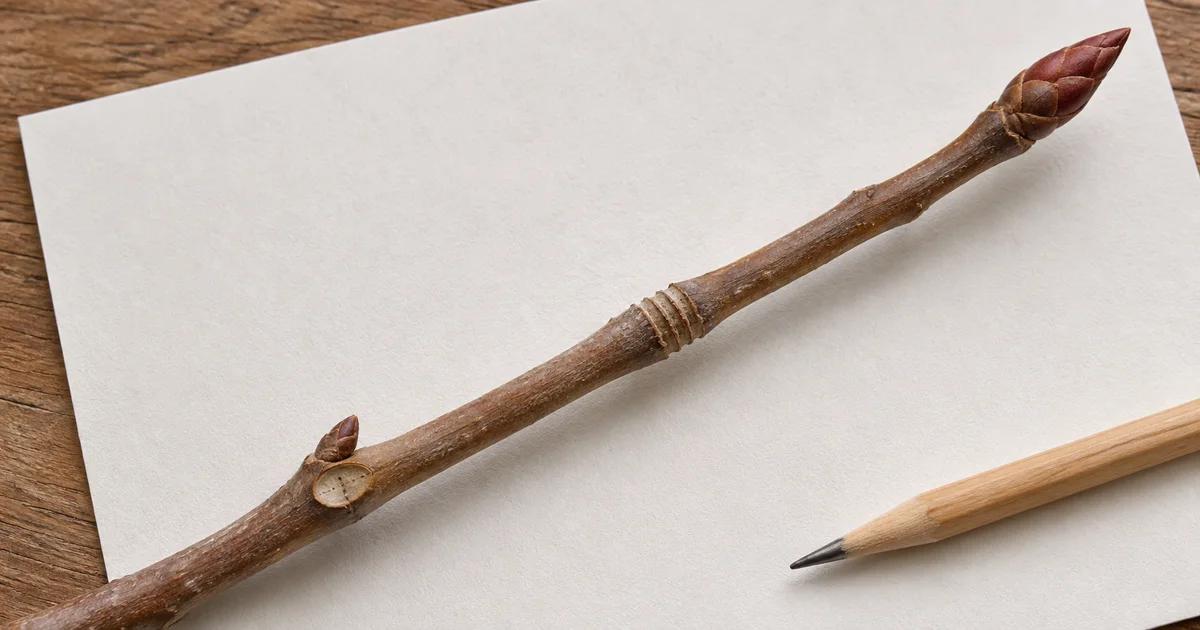
On a straight dormant shoot, find the bud at the very tip, then work inward until you reach the first clear band of bud scale scars. When the last terminal bud opened, its protective scales fell away and left marks. On a shoot with an intact tip and a distinct band, the length between them shows roughly how far that shoot grew during its most recent season.
Does the mark continue around the back?
A crescent under a side bud may be the spot where a leaf stalk once joined the twig. Check the other side. Fine lines left by terminal bud scales form a band around the shoot. Move a step to the side so you can see the back while leaving the twig in place.
Bring the ruler alongside the twig
Pick an accessible, fairly straight shoot with an unbroken end. Follow it back from the terminal bud until you can pick out the first distinct band.
Hold the ruler parallel to the twig with zero at the band. Bring the scale and the twig into the same plane, look from the side and read the distance to the tip.
Take one frame that includes the band, the tip and the scale. Take another to show the back of the band. If the scale looks slanted in the picture, use your reading from the spot. Leave the distance blank if you didn't take one.
A mark at 3 cm and a band at 8 cm
In this worked example, a small crescent sits about 3 cm back from the tip. A set of fine lines appears about 8 cm back. From the other side, the crescent disappears behind the twig. The narrow band continues around it.
The note for this shoot can read “about 8 cm from the first band to the terminal bud.” On another twig, a crossing branch might block the reverse view. “Couldn't check the back” keeps that observation open for your next walk.
Leave yourself a way back to the same shoot
Put the close-up and a wider view of the fork in Pogaem on the day of your walk. A note like “low branch facing the bench” helps you find the same shoot when its buds begin to open.
Frequently asked questions
What if the tip has broken off?
Part of the length you want to measure is missing. Leave the break alone and look for another twig with both its end bud and the first band intact.
What if the bands are crowded together?
On a short spur, bands can be too close to separate confidently. Note that the boundary was hard to read and practice on a longer shoot with more space between bands.
Does this measurement tell me how old the tree is?
You measured one shoot's most recent length of growth. The age of another branch or of the whole tree would require different evidence.
Sources
- University of Illinois Extension on reading terminal bud scars · Accessed: 2026-11-25