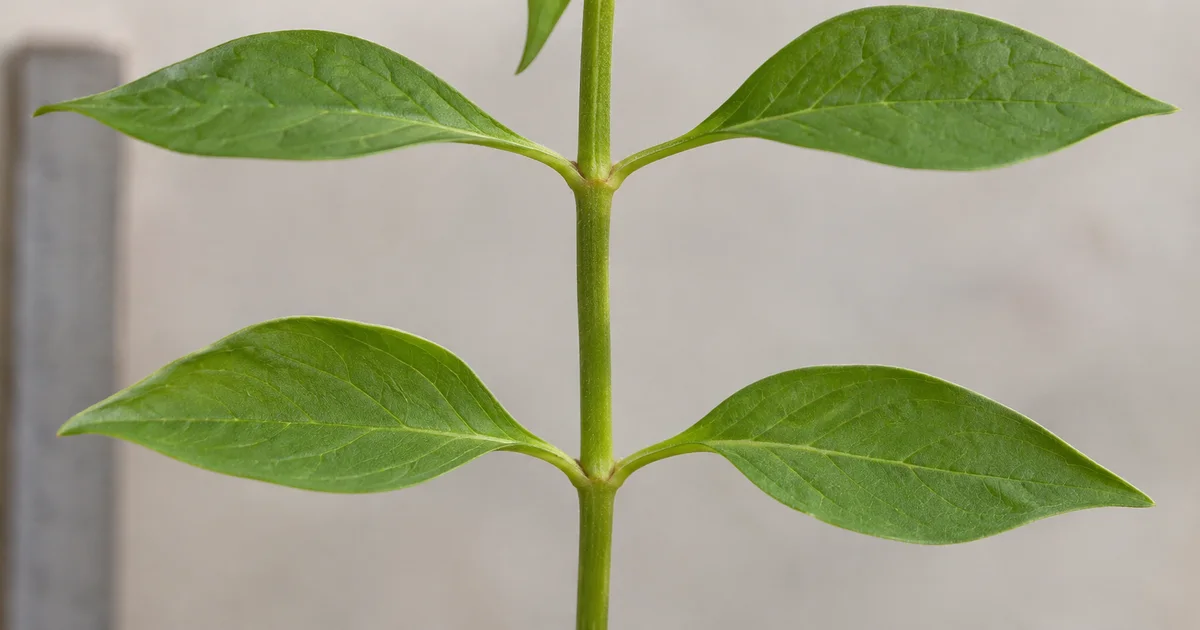
Follow each leaf back to the stem
When two leaves seem to face each other, trace each one back to the stem. A node is the point on the stem where a leaf attaches. Lower your eyes to stem level and look at the two attachment points. Are they directly across from each other, or is one a little higher?
Count whole leaves at one node
Alternate leaves attach one per node. In a side view, you may see one leaf on the left and the next one higher up on the right.
Opposite leaves attach in pairs on opposing sides of the same node. The pair above can point in a different direction.
Whorled leaves attach in groups of three or more around one node. A crowded shoot tip can also have several separate nodes very close together.
What the side view adds
In our worked example, two leaves look like a pair in the overhead photo. From the side, the left leaf attaches at the lower node and the right leaf at the next node up. A look around the back confirms one leaf at each.
A usable note reads “Lower node: one left. Upper node: one right. Alternate on this stretch.” If both leaf bases met the stem directly across from each other at the same level, the note for that node would instead read “Two opposite leaves.”
Several leaflets can share one stalk
A compound leaf divides into leaflets. If several blades all lead back to the same stalk, keep tracing that stalk to the main stem. Counting each leaflet as a whole leaf can give you the wrong arrangement. If the attachment is hidden, leave the classification open.
Name the part you could see
Photograph the stem from the side with both nodes in view. Save the picture on the observation date in Pogaem and identify the shoot in your note. If you couldn’t see behind it, “One leaf visible at the lower node, back unchecked” tells you exactly what to look for next time.
Frequently asked questions
Can I lay loose leaves on the table to work this out?
A loose leaf generally won’t show which node it came from. Look at the plant with the leaves still attached.
Do I need to draw on the photo?
You can follow each leaf base with your finger on the screen. For a paper sketch, one line for the stem and a mark for the height and direction of each leaf is enough.
Does leaf arrangement tell me the species?
Many species share an arrangement. Record the pattern you can see on this shoot, then consider other features if you want to identify the plant.
Sources
- Botanic Gardens Conservation International’s guide to botanical observations · Accessed: 2026-11-23
- Kinmen County Forestry Bureau’s diagrams of leaf arrangement and compound leaves · Accessed: 2026-11-23