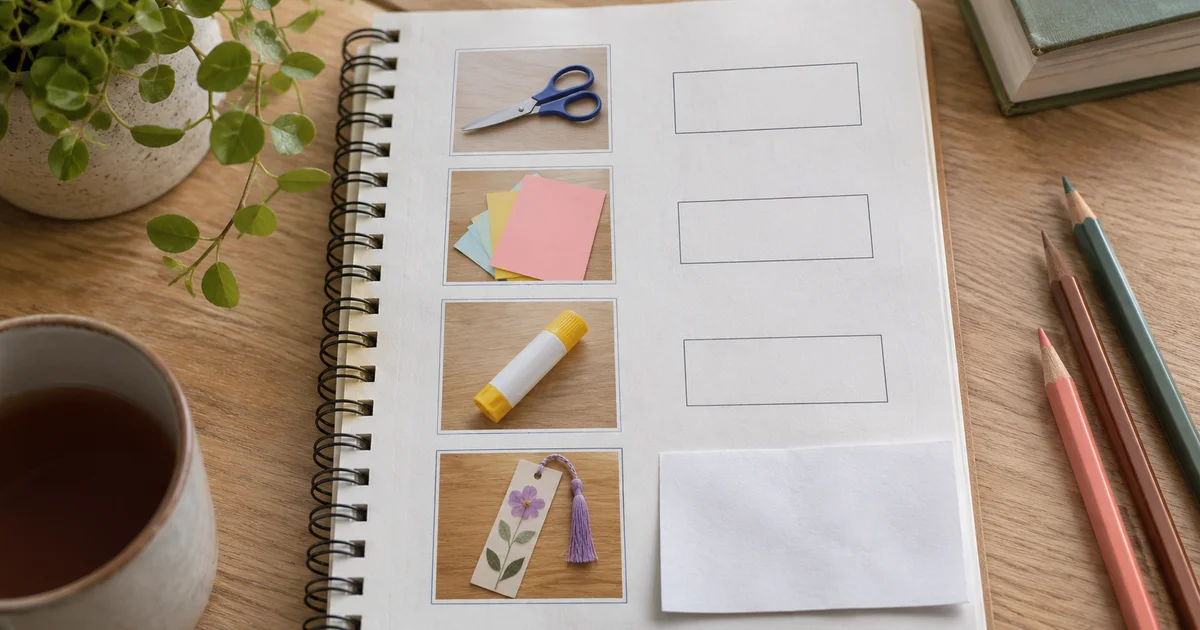
Choose one word from one photo
To make a photo vocabulary notebook, choose one object in a photo you took. Check the word, its meaning, and its part of speech in a dictionary, then add a short sentence of your own. Later, cover the written answer yourself and try to recall it from the photo.
You do not need to name every object at once. For a desk photo, start with the bookmark. A concrete object can give you a clear link between picture and word; consider separately whether a photo conveys an emotion or abstract meaning precisely enough for your purpose.
Fill in five fields yourself
Object in the photo: identify exactly which thing you mean when several are visible.
Checked word and part of speech: select the relevant meaning when a word has several uses.
Meaning for this entry: briefly explain the sense you are using in this scene.
Your own sentence: write a short sentence you actually want to say about the pictured object.
Source checked: keep the dictionary name or address and the date so you can return to it.
One entry for an English speaker learning Spanish
Here is an original editorial example: “Object: the blue paper bookmark between the pages / word: el marcapáginas, masculine noun / meaning: a bookmark that marks a place in a book / my sentence: Pongo un marcapáginas azul en mi libro. — I put a blue bookmark in my book / checked: Cambridge Spanish–English Dictionary, marcapáginas entry, November 19.” The sentence was written for this example rather than copied from the dictionary.
This entry focuses on a physical reading marker. Check the particular sense and local usage you need, especially when English uses the same word for a browser feature. For pronunciation or another target language, consult an appropriate dictionary. The photo’s colour or shape alone cannot confirm that you have chosen the right word.
Cover the answer and revisit the picture
Cover the word, meaning, and sentence in your paper notebook with a slip of paper. If using a screen, choose your own way to view the picture without reading the text.
Say the object’s name or write it on a separate sheet, then try a short sentence using it.
Uncover your note and compare the spelling and selected meaning. Record what you could not recall without filling in a success you did not have.
Return to the source for a confused meaning. If useful, take a clearer object photo or rewrite the sentence to fit your scene.
Keep the photo and word on the day you noticed them
Keep the everyday photo and the entry you filled in on that date in Pogaem. A title such as “Desk — marcapáginas” names both the object context and the word. If you later want to write about your day in the language, continue in another entry. A vocabulary item and a narrative about your day serve different purposes.
You choose the word, check its meaning, and cover the answer yourself. This method does not assume automatic translation, object recognition, or an automatic quiz. Check your photo for other people’s faces or addresses, and keep the source address and your brief notes rather than copying long dictionary explanations.
Frequently asked questions
Can I add several words to one photo?
Yes, if you clearly identify the object for each word. Starting with one makes it easier to complete and check its meaning and your sentence.
What about words that are difficult to picture?
Consider whether the picture and word really match. You can describe a situation in writing or collect the expression in another format instead of forcing it onto an object photo.
How is this different from a foreign-language diary?
Here you connect one object with a particular word meaning and try recalling it. A diary focuses on joining sentences about what you did and thought that day.