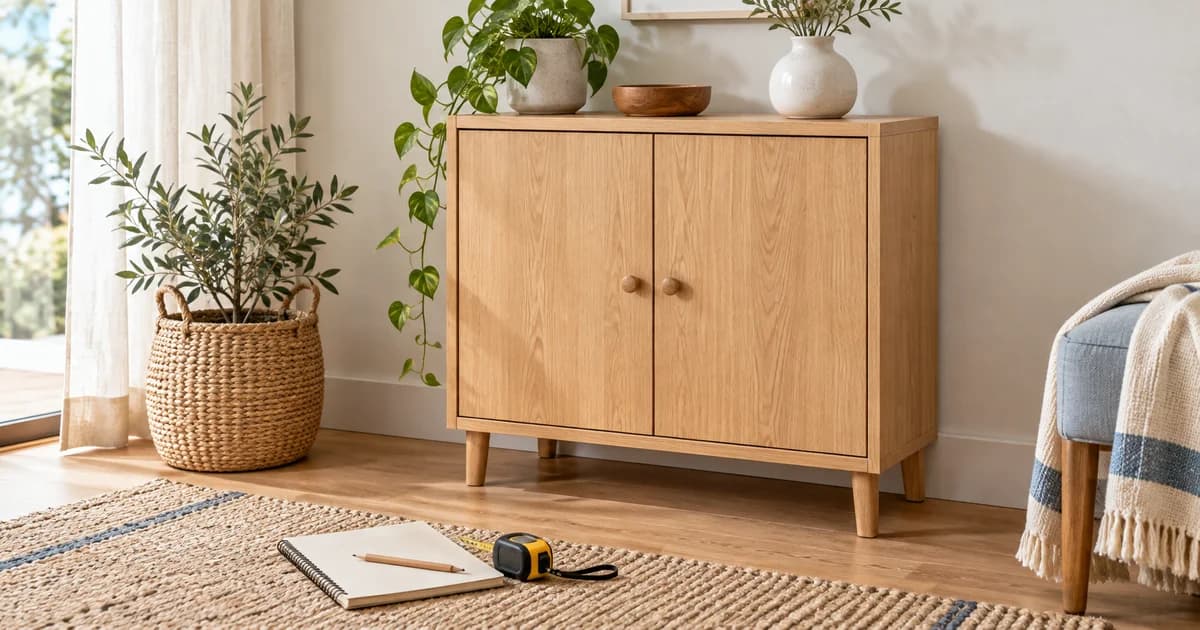
Name the furniture and its intended space separately
Begin each measurement with what you measured: “Bookcase body” and “Wall space for the bookcase” refer to different things. A bare “80” will not identify either when you read it later. If a number came from a product listing, keep its source distinct from a value you measured yourself. The same entry can hold both without presenting them as the same observation.
Describe width, depth, and height in relation to the furniture's orientation. The vertical direction on a top-down photograph is not necessarily the object's height. Use an overall picture or words to explain which face you treated as the front. That reference lets you interpret each direction consistently even when the detail photo was taken from a different angle.
Give every value a unit and two endpoints
An invented editorial format is “Cabinet A / front-facing left-to-right body width / left body edge to right body edge / 80 cm / handles excluded.” This is not a real product dimension or a recommended size. Instead of writing only “80 × 40,” explain what each value measures. Keeping the number beside its scope is more useful than leaving a familiar-looking pair of dimensions.
If both endpoints are not visible in the image, explain their locations in the note. Leave an unmeasured section blank or unconfirmed instead of filling it from perspective. When someone else supplies a measurement, identify that source and its known basis. A number received from another person can remain useful without being rewritten as a measurement you personally performed.
Make a photo note with readable measurement context
Give the furniture and its intended space different names, and keep an overall photo.
Add the direction, endpoints, and unit to each value, stating whether the body or protruding parts were included.
Record the closed state separately from any space you actually checked with doors or drawers open.
Compare listing dimensions, direct measurements, and the actual arrangement, leaving necessary unchecked items visible.
State whether handles and open doors are included
A measurement of the body's depth may differ from one extending to the end of a handle. Write “Body only” or “Including handle tip” to preserve the boundary you used. A photo with a door or drawer open also shows a different state from the closed cabinet. Label that state rather than treating both pictures as views of one unchanged measurement.
If you have not checked the space used while opening it, do not decide the closed-state photo proves that space is sufficient. Leave a question about the opening direction and the part still to check. This is a way to describe your measurements, not a design guide calculating installation safety or usable clearance. An unanswered question should not become a confirmed fit.
Read the measurement basis before resolving a mismatch
When a listing and your note differ, first check whether they describe the same object and direction. Packaging size, body dimensions, and the assembled state can become mixed together. Even with the same product name, record only what you know about the model and configuration you checked. The difference may remain unresolved until the terms of both measurements are clear.
Before copying a number again, check the unit. Different measurement boundaries do not by themselves establish that either value is wrong. Add the checking date and source, followed by what you still need to ask. Avoid converting a unit from memory or diagnosing measurement error from the photo alone. Keep the two values attributable while you work out what each actually describes.
Keep later arrangements separate from the earlier measured state
After a move to another room or the addition of a component, the old photo describes the earlier state. In a new entry, identify the changed object or location and add only values you checked again. If sharing with family, comments can explain who measured which direction. That additional context is more informative than an unlabeled number copied from the earlier arrangement.
Pogaem photos and notes can gather the context of dimensions you verified yourself. This does not describe automatic measurement from images or AR furniture placement. The note alone cannot guarantee that an item can be brought in or installed safely; confirm the relevant real conditions separately. Its own task is to make a known number readable as a measurement of a particular thing.
Frequently asked questions
Can I determine furniture size just by taking a photo?
Do not establish actual lengths from perspective alone. Note what you measured directly, its direction, endpoints, and unit, and label anything you did not measure.
Why state whether a depth measurement includes handles?
The cabinet body and the distance to a protruding handle can have different boundaries. Recording the scope lets you interpret the value the same way later.
Which should I use when listing dimensions and my measurement differ?
Keep the sources separate and first compare the object, model, unit, and measurement boundaries. The difference alone does not establish its cause.