Give the tree a narrator
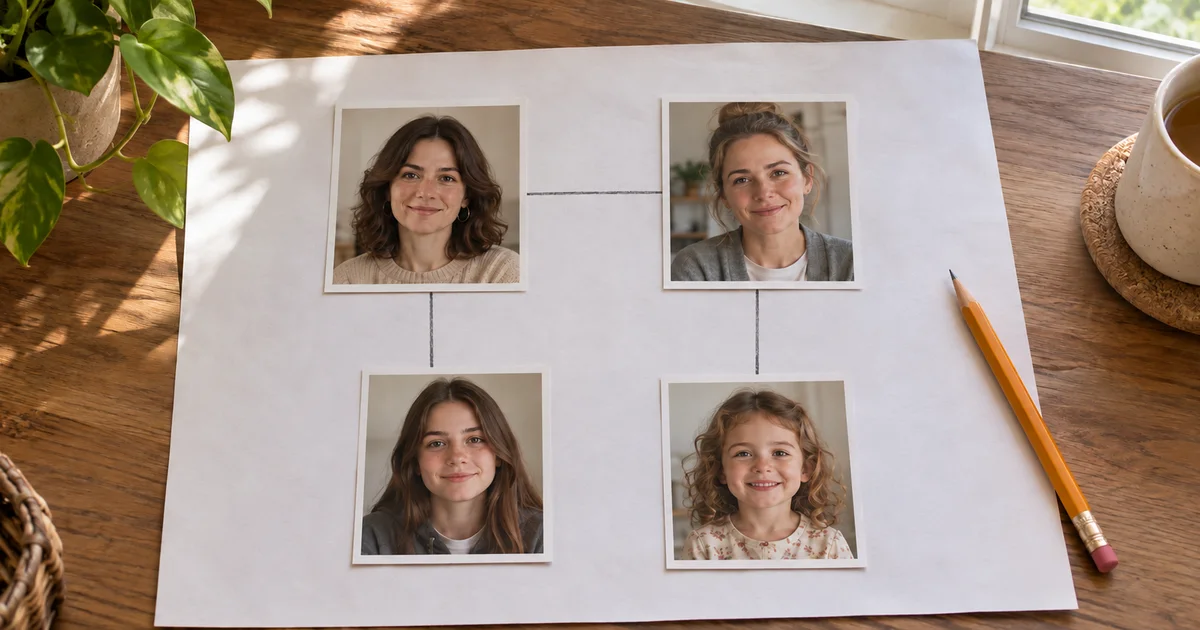
Put the child’s picture in the middle of a sheet and write “me” underneath. As each new picture goes down, ask what the child calls that person. Put names under pictures and relationships on the lines between them. That gives the child something to say at every step.
The US National Archives offers a family photo tree activity and charts for different family arrangements. At home, you can tape on another sheet if a branch needs space. Let the child choose whom they want to introduce today.
Trace a path through four people
In this invented example, Maya is Jo’s child. Jo and Tess are sisters, and Kit is Tess’s child. Put Jo and Tess side by side and write “sisters” on the line between them. Put Maya below Jo and Kit below Tess, then connect each child to their own parent.
Start at Maya and follow the cards through Jo and Tess to Kit. Maya can read it aloud as “My mom Jo has a sister, Aunt Tess. Her child Kit is my cousin.” Now trace the line from Kit back to Tess. The same person Maya calls Aunt Tess is Kit’s mom.
Try the layout before you glue anything
Write the four names on separate scraps of paper so the child can move them. Add a photo beside a name when the person is comfortable using it.
Connect the sisters, then add the two children below. Label the parent–child lines so a reader can tell who is whose parent.
Ask the child to find their cousin. If a crossing line leads to the wrong picture, move a card and try again before sticking it down.
A name can hold a place
If the child usually says “Auntie Tess,” use that on the card. When a connection is unclear, ask the person how they describe their place in the family. Resemblance between two faces is a poor reason to draw a line.
Keep the child’s own introduction
Photograph the finished sheet and save it in Pogaem on the day you made it. Add the sentence the child read aloud. Before showing the chart outside the family, check which pictures and names people are comfortable sharing.
Frequently asked questions
Can I include a cousin whose photo I don’t have?
Write their name or nickname on a card, or let the child draw a picture. That holds their place as clearly as a photograph.
Do my aunt and cousin have to go in different rows?
You can move the cards to fit your paper. Make the parent–child link from Tess to Kit easy to tell apart from the link between the two sisters.
What if we call the same person different things?
Use the child’s name for that person on this tree. To show a different viewpoint, add a sentence such as “Tess is Kit’s mom.”
Sources
- US National Archives family tree activities for children · Accessed: 2026-11-22