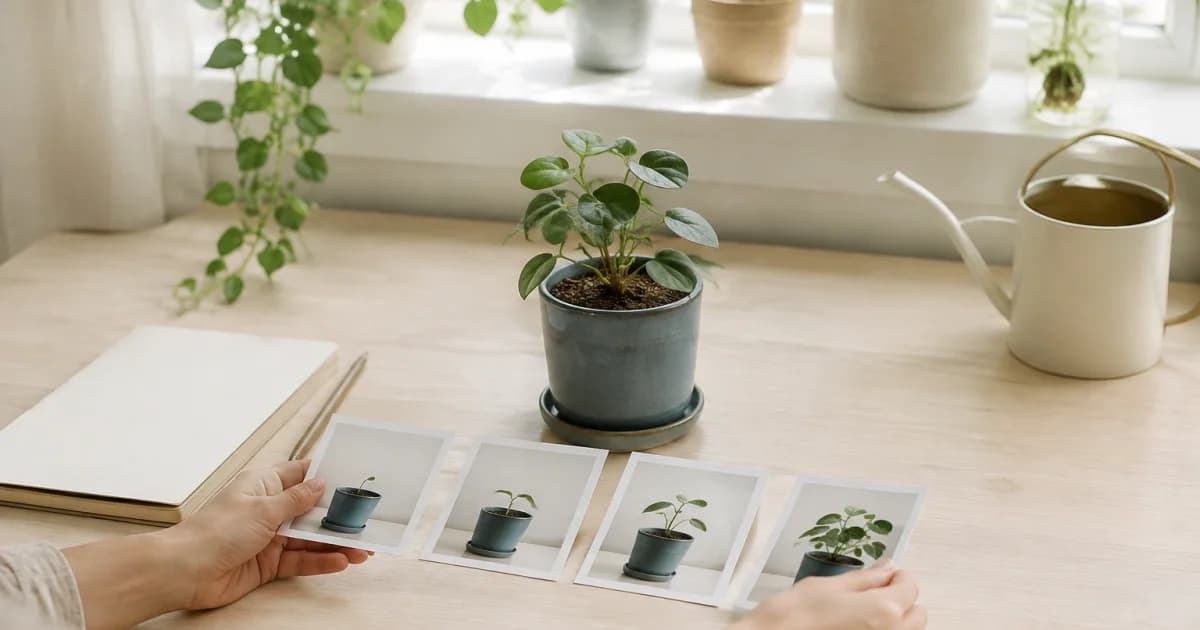
Give the parent plant and each cutting different names
Repeating a species name beneath similar leaves may not tell you which original plant a cutting came from. Give the parent a recognizable name such as “Window plant A,” then name its cuttings A-1 and A-2. These are labels you choose to distinguish your plants. They do not authenticate a variety, prove genetic lineage, or identify something whose origin you never knew.
If you are recording an offset you already separated, call it an offset rather than changing it into a cutting in the notes. “Offset A-3, separated from A” describes that relationship. The aim is to remember which plant came from which, using the events you actually know. This is a record of propagation you have undertaken, rather than instructions for where or how to cut.
Several cuttings in one jar are still separate plants
An invented editorial note is “Parent A → cuttings A-1 and A-2 / initially together in glass jar B.” Here B identifies the container; A-1 and A-2 identify the cuttings inside it. If only A-1 later moves to a white pot, record that particular move. A photograph of the new pot should not imply that A-2 went there too.
Keep an overall photo and, where useful, closer photos that distinguish the individual cuttings. Include their labels in the picture and repeat the same names in notes taken after a move. A name based only on shelf position or pot color may stop working when the plant changes places. The cutting's identifier can remain the same even when its current container changes.
Connect the parent with the new pot in four steps
Choose a recognizable parent name and overall photo, then give each cutting or offset its own identifier.
Record the separation date as far as you know it, with the parent and new plant names in one note.
When moving or dividing containers, connect the particular plant moved with its new container and a photo.
If you give a plant away, note which one and when, labeling later updates as information received from its new keeper.
First noticing a change is different from knowing when it began
If roots are visible in today's picture, write “October 26: roots visible on A-1.” Unless you checked continuously, you may not know when they first appeared. A new leaf can be recorded in the same way: say when you first saw it, without turning that observation date into a confirmed starting date. Later photos can then be read against what you actually noticed.
For another cutting, “Not visible in this photo” may be all you can say. Lighting, an obscured area, or the camera angle can limit what the image shows. Keep those limits in the note instead of treating a missing detail as a result. The diary does not decide propagation success or failure, and one cutting's visible change does not establish what happened to the others.
Leave an uncertain relationship uncertain
If cuttings become mixed and you can no longer tell which was A-1, write “Individual identities unconfirmed.” You can give the plants distinguishable new names from this point onward and connect only the photos you can match. Guessing that the last remaining cutting must be a particular earlier one can make the whole sequence harder to read. An acknowledged gap preserves what is still known.
For a photo received after giving a plant away, note who sent it and which plant they say it shows. A picture taken in someone else's home is not a change you observed firsthand. If you later confirm the relationship, add the confirmation and its date beside the earlier uncertainty. You need not erase the original note to show that you now have more information.
Repeat the plant names in dated Pogaem entries
Use an identifier such as A-1 in your Pogaem entry title or text as well as beside the photo, and keep the date of the event or observation clear. Several photos on one date can show the parent, its cutting, and the pot it moved into. For a small collection, one plant calendar is enough to begin; separate calendars for every cutting are not necessary.
If you keep a shared calendar with someone else, agree on what the names mean and use comments to ask about a missing connection. The parent-to-cutting relationship and any list of plants are notes you write yourself. Pogaem does not build a plant family tree or diagnose plant condition. The useful part is the connection you can explain between the names, photos, and dates.
Frequently asked questions
Should I separate records for several cuttings from one parent?
Give them separate names if you want to follow which container each one went into. You can still keep their photos in one dated entry, connecting the parent and each cutting in the text.
What if I cannot remember when I separated the cutting?
Leave the separation date unconfirmed and record the date and appearance you can observe now. Taking a photo today does not mean the cutting was separated today.
Can these photos tell me whether roots are developing well?
This log records what you could see. It does not establish plant health or propagation success from a photograph. Use separate guidance suited to the plant and its conditions for cultivation decisions.