What should the back look like?
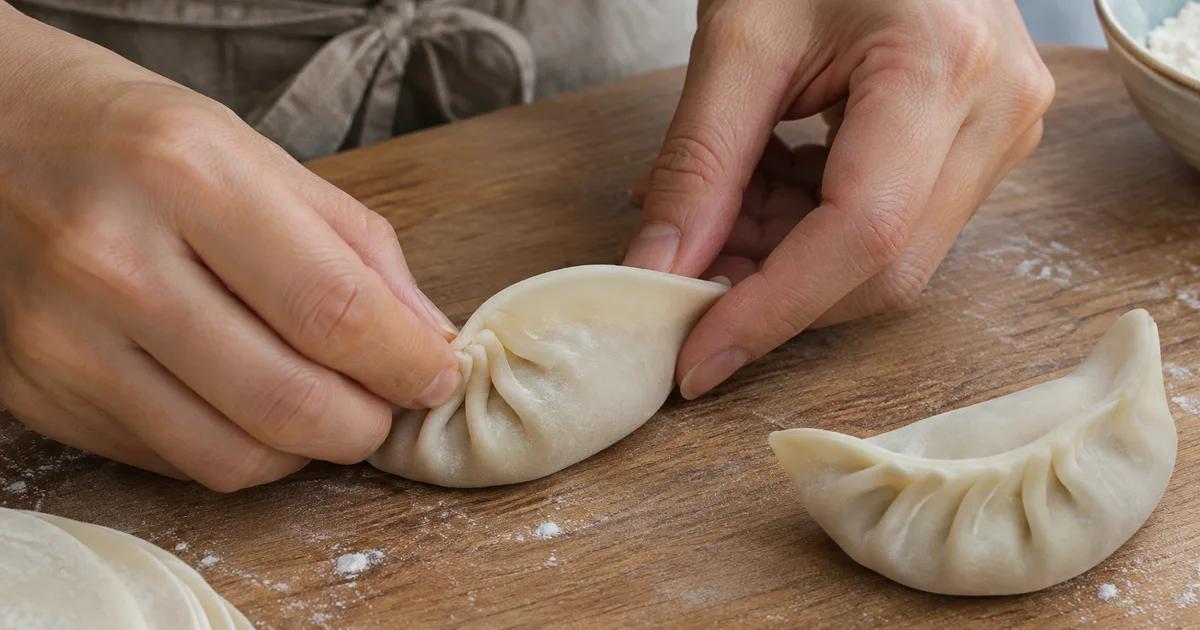
Put a little filling in the middle of a round wrapper and bring the edges up. Gather folds on one edge while keeping the opposite edge smooth. Pinch each fold to that backing to form a pleated crescent. Turn the same dumpling around to see what happened on both sides.
Work from one corner to the other
Leave a clear border around the filling. If your wrappers call for water to seal them, lightly moisten the rim as directed.
Pinch one corner closed. Support the edge you want to keep smooth, then gather a small fold of the opposite edge toward the corner you just sealed.
Press the fold against the smooth edge, move over a little and repeat in the same direction. At the far end, check that the two edges meet all the way to the corner.
Take a picture of each face
Stand the dumpling on a plate with the overlapping pleats facing you. Take a picture, then turn the plate halfway around. If the backing is folded over at every pleat too, try holding it flat with your supporting hand on the next dumpling. A side view can help you see a particularly thick spot.
The Woks of Life demonstrates a one-directional fold by working one edge toward the sealed corner. The number of pleats can vary with the wrapper. For this exercise, leave enough room to join the edges at the end before adding another fold.
Change one thing on the next dumpling
In this invented kitchen example, the first dumpling has three tidy pleats and a peek of filling at the last corner. The note reads, “Ran out of rim to pinch at the end.” For the next one, use the same wrapper size with a little less filling.
If the edges now meet, write “With less filling I could pinch the last corner.” A picture taken before cooking shows the join you made. You’ll have to cook it to find out whether it holds.
Save the view you want next time
On the practice date in Pogaem, save the pictures under a title like “Crescent dumplings, last corner.” Next time you lay out the wrappers, look at the ends of the two dumplings to recall the change in filling.
Frequently asked questions
Can I work from the other end if I’m left-handed?
Start at whichever corner feels comfortable. Keep gathering the same edge toward the corner you have already sealed.
Should I pull it apart if the back also has pleats?
Check the current dumpling for visible gaps. Try supporting the back edge on the next one so you can practice without pulling apart a finished seam.
How many pleats do I need?
There is no target count for this fold. If the wrapper starts pulling tight, check that you can still bring the edges together at the end.
Sources
- The Woks of Life’s one-directional dumpling pleat demonstration · Accessed: 2026-11-22