Put the room on the paper
Draw the shape of the table and mark a fixed feature or two, such as the window and the door. Add a name at each actual chair. When a guest turns the paper so that the window on the sketch lines up with the real window, the names point to places they can see.
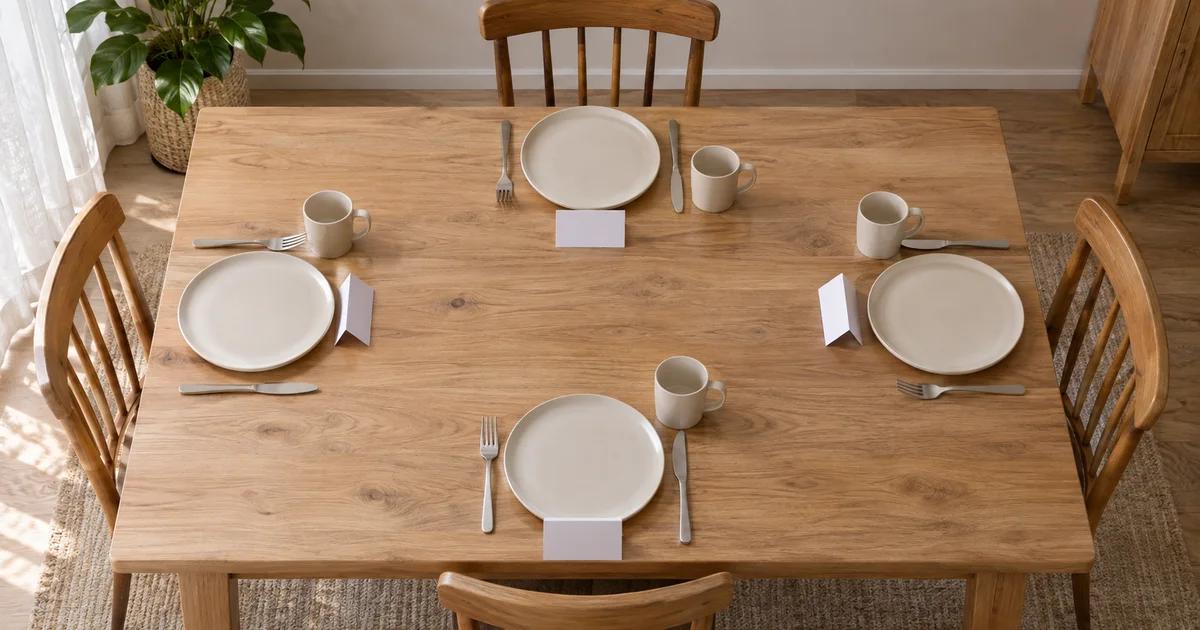
Before anyone arrives, stand in the doorway and photograph the empty table. Choose a window frame or kitchen entrance that you can recognize both in the picture and on the plan. With no point of reference, someone can turn the sketch around and swap left and right without noticing.
Map four chairs around a rectangle
Place two chairs on each long side. Leave the short ends empty in this layout and make sure the chairs can actually pull out.
Write “window” across the top of the paper and “door” at the lower left. Sketch two places along the window side and two along the door side.
Write a first name or familiar nickname at each place. Ask whether anyone would like a particular spot before assigning the chairs.
Go to the doorway and use the sketch to find one seat yourself. If you put out place cards, check each one against the name on the paper.
Find the seat from the doorway
For this fictional dinner, the window runs across the top of the sketch and the door sits at the bottom left. Reading the page from left to right, the window side seats Bea and Sam. The door side seats Dani and the host. Neither short end has a chair.
Dani comes in and faces the window. Their name is on the lower left, so they can take the left chair on the near side without walking around the table. Bea is directly opposite and the host is to the right. Those two neighbors confirm Dani is reading the plan the right way up.
When two people trade places
Suppose Sam and Dani agree to trade. Move both names on the plan and move their place cards. Sam is now on the left of the door side. Dani is on the right by the window. If the crossed-out sketch is difficult to read, copy the two short rows onto a fresh sheet.
A guest-facing plan needs the seating arrangement. Keep any personal reasons for a request private. Once the places are set, try pulling out the chairs with the guests who will use them and check the route past the table together.
Keep the layout that worked in this room
Save the empty-table photo and final sketch together in a Pogaem entry for the dinner date. Next time you use the room, you can see where the chairs went. If you send a picture, choose a view that shows the places your guests need and consider who should see a plan that includes names or part of your home.
Frequently asked questions
How do I start a chart for a round table?
Draw a circle and mark the chair closest to the door. Work around the real table in one direction, adding names to the drawing as you go.
Do I need individual place cards too?
A readable sketch may be enough. If one row has several identical chairs, a card at one seat can give guests a starting point.
Can I add another guest to the drawing?
First put the extra chair in place and see whether people can sit down and walk past. Add it to the plan once you know where it goes.