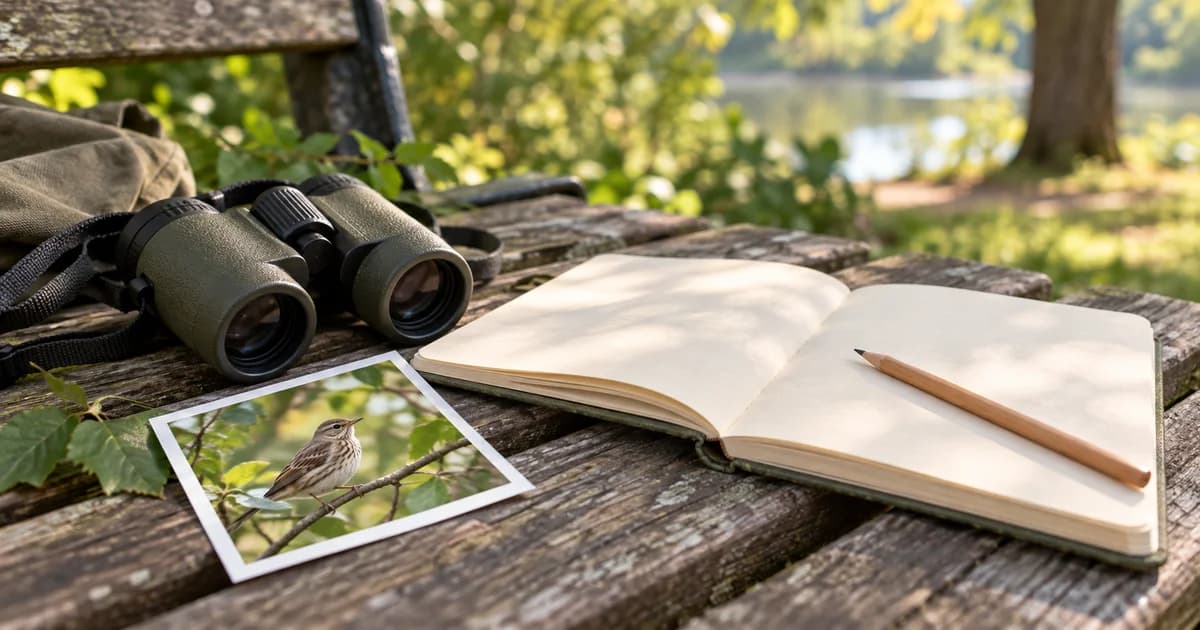
Write what you saw before deciding on a name
You can start birdwatching field notes without knowing the bird's name. Write the features and behavior you actually saw, such as ‘A small brown bird perched on the railing.’ Keep a resemblance to a familiar species separate from a confirmed observation. If you did not see a wing pattern, do not add it later simply because it appears in the field guide's illustration.
A movement or sound can be harder to remember later than the scene in a photograph. Leave a short note while the details are still available instead of waiting for a perfect bird photo. If you heard a call but did not see which bird made it, write that distinction: ‘Sound heard nearby; caller not observed.’ You still have an observation worth keeping without assigning the sound to a species.
Give the observation its own time and location
The duration of a walk and the moment you saw a bird are different information. If you briefly watched one during a morning walk, record the time range you know. Mark it approximate when you did not check a clock. A general location such as ‘path beside the park pond’ can distinguish this sighting from a later visit without requiring an exact position in every note.
An editorial example is ‘Around 8 a.m. / neighborhood park pond / moved from the railing to the ground / name unknown.’ This shows a note format, rather than reporting a real sighting. Seeing a similar bird there another day does not establish that it is the same individual. A date when you did not visit is a day without your observation, rather than evidence that no birds were present.
Connect a sighting with a later check
Use the actual observation date. Add the general location and the time or approximate period you remember.
Separate visible features and behavior from sounds you heard. Leave features you could not see unfilled.
Add photos from that observation if you have them. Label a name found afterward as a possible identification where uncertainty remains.
On another visit, create a new entry. Compare its observed clues with the earlier note without treating them as one sighting.
Add the basis and date of a possible identification
A field guide or reliable observation resource may suggest a name afterward. Add what you compared and what remains unresolved: ‘Possible identification checked later: [name]; wing pattern not visible in my photo.’ There is no need to force a species-level conclusion from a blurred image. A tentative label tells your future self which part needs checking, while the original description remains a record of what you saw.
If a different identification is confirmed later, retain the field observation instead of rewriting it to match the new explanation. Add the date of the check and identify the reference separately. Pogaem provides space for these dated photos and personal notes. This method does not describe an automatic species identifier or a tool that recognizes calls; any identification in the note should reflect the evidence you checked elsewhere.
A missing photo or uncertain count does not erase the sighting
When the bird flies away before you can photograph it, use text alone or a landscape photo that recalls the place. Do not present a bird photo from another date as documentation of this sighting. With a blurry photo, describe only the details it supports. If a detail comes from your memory rather than the image, identify it that way instead of making the photograph appear more informative than it is.
If you saw several birds without counting them, ‘several; exact number unknown’ is a usable note. Do not add every repeat arrival as another individual when you cannot tell them apart. A personal field journal is not a requirement to fill every numerical field. Its value here is preserving the boundary between what you confirmed, what you only estimated, and what you did not observe closely enough to say.
Keep each person's observations recognizable in a shared note
With a companion, a shared calendar can hold each person's photos, notes, and comments. Attribute an observation such as ‘I saw a white patch near the wing’ to the person who saw it. Different memories of the same scene need not be merged into one confident account. Keep the separate observations readable instead of allowing one person's tentative identification to replace everyone else's description.
You do not need to approach a bird more closely or search for a nest to complete a note. Follow the site's access guidance, and consider whether a shared version needs information revealing a sensitive habitat location. A short observation without a bird photo can still leave a useful question for the next walk. The goal is a record you can interpret later, with the limits of the observation intact.
Frequently asked questions
What can I write if I do not know the bird's name?
Start with colors, approximate size, behavior, the time period, and a general location you actually observed. Leave the name blank or label a possible name as tentative rather than filling in features you did not see.
Can I keep an observation in Pogaem without a bird photo?
Yes. You can make a text-only entry or use a landscape photo from that day to recall the place. Do not label a bird photo from another date as a photo of this observation.
Can Pogaem identify the bird automatically?
This article explains a dated observation journal. It does not describe automatic bird or call recognition. Record names according to the evidence you check in separate resources, keeping uncertainty visible.